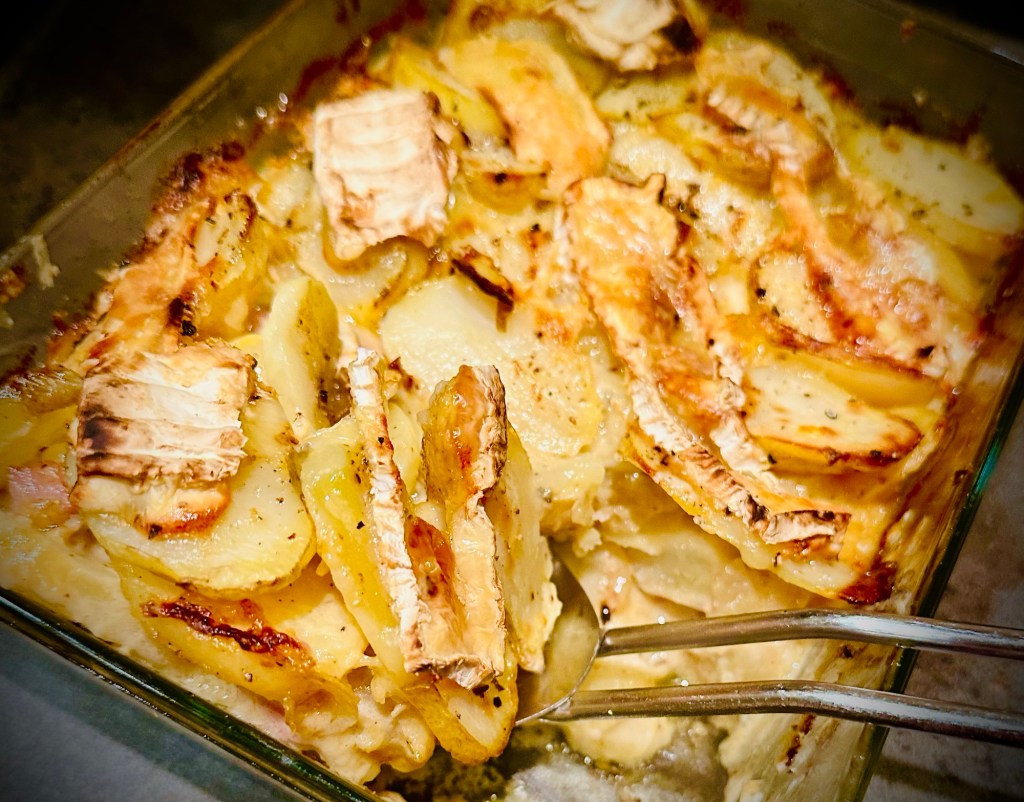
Rich and cheesy and loaded carbs this rustic dish seems as much a traditional part of the alpine landscape as log cabins and pine trees.
Potatoes, cream, bacon and cheese – simple farmhouse fare for the fired and hungry.
It was with surprise whilst I was doing a bit of research for the true authentic recipe that I couldn’t find it in all the classic places.
No mention from Ann Willan nor Elizabeth David.
Patricia Wells in the excellent Bistro cooking has a recipe for Pommes de Terre Comtoises, a dish with potatoes, ham and cheese, Gruyère in this recipe.
On further searching the reasons are interesting.
The tartiflette is a marketing creation from the 1980s. likley to be derived from the language of Savoie and Haut Savoie the local dialect for potato being “tartiflâ ”
In the 1980s Union Interprofessional Reblochon, the local cheese consortium promoted the dish to promote their cheese.
It’s not dissimilar to other dishes from the mountains regions.
Potatoes (gratin) Daupinois, Gratin Savoyard, Swiss raclette and tortino di patate alla Valdostana from across the border are in the same family
I’m guessing if you want to make a “traditional” Tartiflette than Reblochon should be your choice but the combination of lardons, sweet soft onions, potatoes partners with many different cheeses.
I think just as the cheese makers of Reblochon created their own version, so can anybody.
My Recipe:
Parboiled potatoes (Ratte are the variety from Savoie, but most are good
Bacon lardons or chopped ham
White Onion, sliced
Garlic crushed
Butter
Double cream
Cheese (Reblochon or rinded cheese)
Slowly sweat the onions in the butter until transparent and golden. Add the crushed garlic and heat through, cover in double cream and keep warm.
Chopped smoked ham, butter cooked golden onions and potatoes
Fry the bacon lardons/ham chunks.
Slice the potatoes into 1/2 cm slices.
Butter a casserole/oven dish.
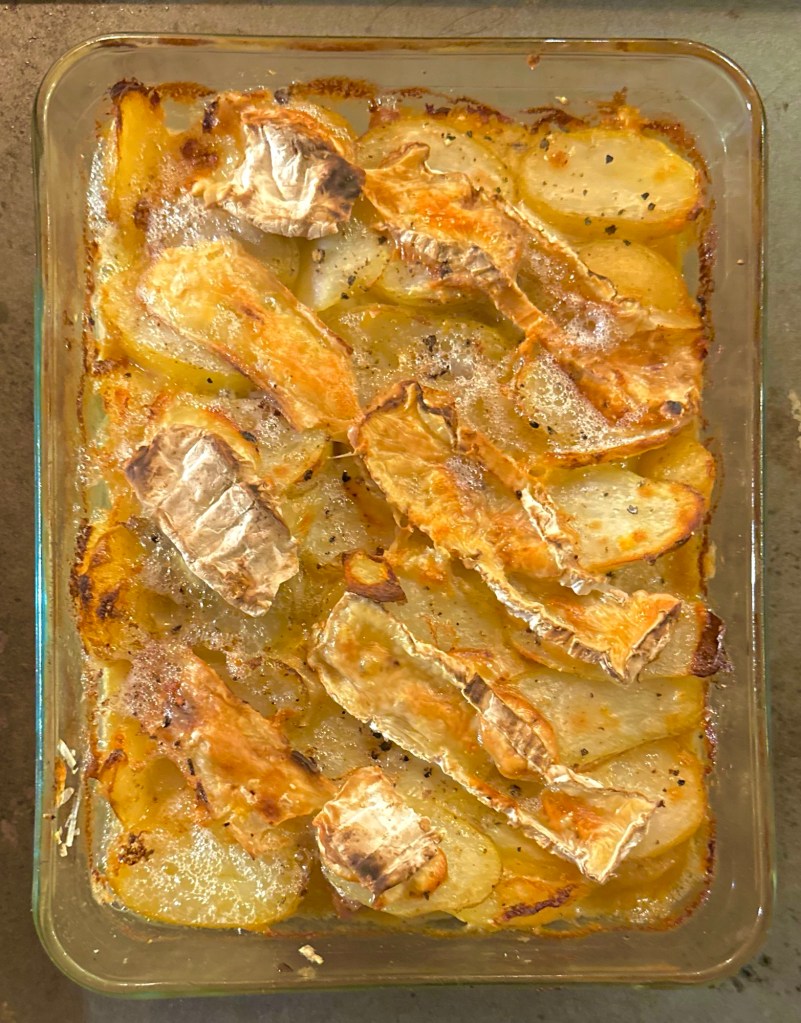
Stack up layers of potato, onion cream mix and cheese. For the top have slices of the cheese with the rind.
Put in an oven at 150 C for 30-45 mins until the whole thing is bubbling and the melted cheese on top blistering.
Have plenty of wine (or tea) to wash it down. Apparently a gastric cheeseball is a risk if you don’t!
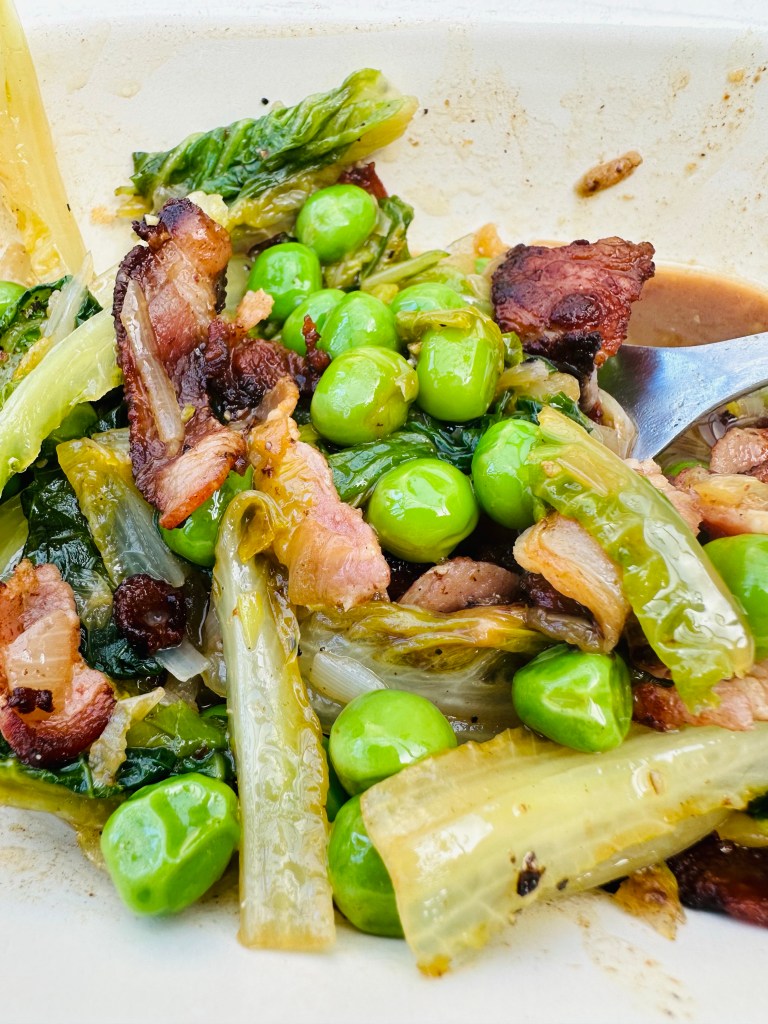
I thought peas with bacon, lettuce and a butter sauce was as classic French as could be.
Ive cooked it many times without even thinking about where I became aware of it.
Pois a la Francois
Maybe its such a a classic that it was a 1980s standard, part of the whole Francophile movement. I don’t remember it as a dish I ate as as part of the family culinary repertoire (which was vast and eclectic).
I don’t remember eating it on my adolescent travels and beyond.
I suspect I saw it on TV or in a sunday supplement. Floyd did a couple of versions so that may be the link.
Looking through my books there are some recipes but most are not classic. Bocuse. No. Raymond Blanc – a dish but its a bit fancied up. Anne Willan – adds a lot of cream. Patricia Wells – doesn’t even stoop beyond pea soup.
Elizabeth David – my usual go to – probably has the best recipe and write up “the difference… is that we cook each pea…separately …often a separate bullet, the french cook them together with a sauce although that often consist only of butter”
At some time I have cooked this from a unremembered recipe and now it makes up a regular dish albeit in different guises.
Today its a bright summer evening and I have some heavy pods hanging off some struggling pea plants. They have put all there energy into those fat pos and are in their dying days.
The pods snap open and reveal green peas of a colour not on the standard scale. They almost glow green. They are sweet. Slightly starchy. Not overly sweet like their wonderful frozen cousins.
Easy. Melt butter. Add very finely chopped white onion. Soften briefly. Add little gem lettuce. Be generous. Then peas and chicken stock.
“What no lardons?” You rightly contend. My preference is to have the lardon in a separate pan. Sweating their curing into some fresh oil (butter).
Tip the peas, lettuce onion stock into the frying lardons.
It reduces the chicken stock and deglazes the lardons. Flavour ++
Serve with fresh baguette and a glass of white wine. Most compliment in their own ways.
(Classically tiny onions are used. The sort that are pickled for cocktail onions. Recipes also add sugar. Personally I think adding cocktail onions would be a bad move. They will overwhelm the peas. I like the freshness without the added acid – if you want some a couple of drops of cider vinegar maybe you can get a fresh edge. Up to you0
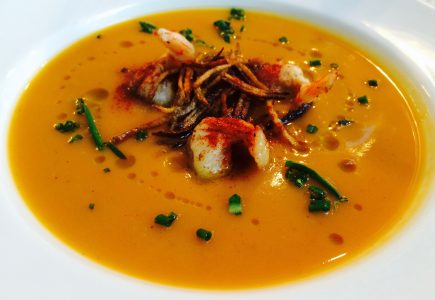
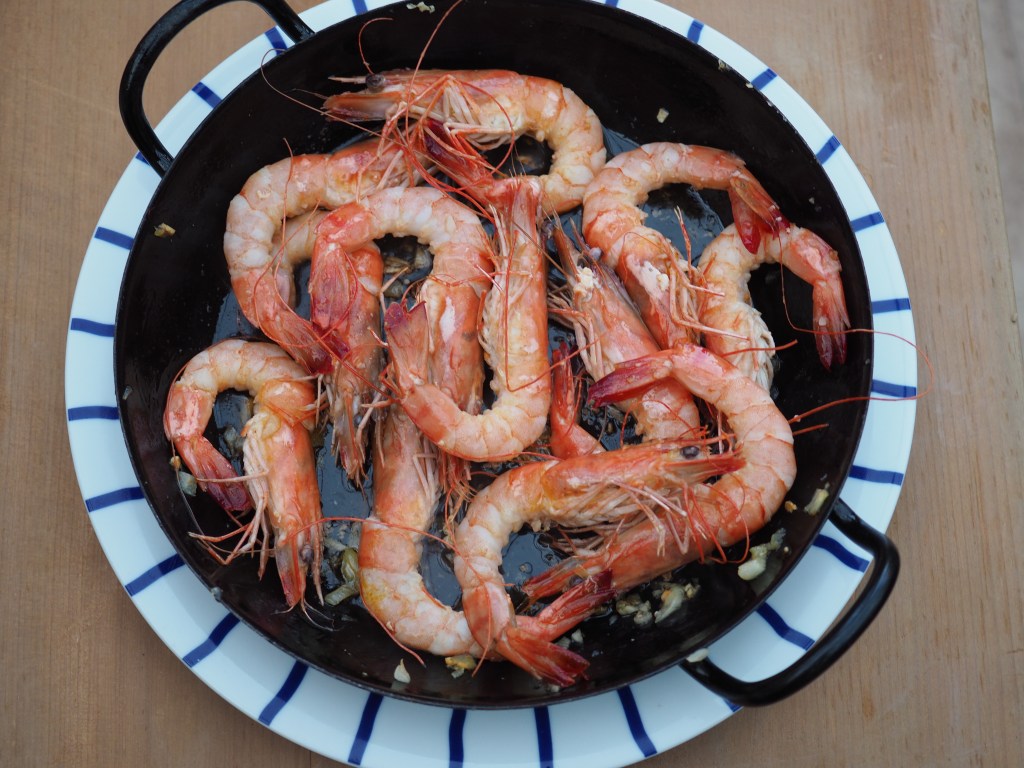
Beautiful fresh shrimps simply heated through in olive oil and garlic until they turn pink.
Gambas al Ajillo (Prawns with Garlic)
They need nothing more. The celebration is the prawn. Twist the head. Suck out the contents (the best bit) then peel the shell.
For these the shell was so thin it was edible right to the tail.
Gambas al Ajillo
Mysurvivalrations tip:
Keep all the left overs – heads tails, garlic, oil – put in a pan with water, some chopped leek tops and some celery. Maybe a slice of onion. You will be rewarded with a lovely seafood stock. All you need do is strain it. Can be used for a seafood rice or get adventurous – coconut milk and red curry paste for a delicious oriental seafood soup.
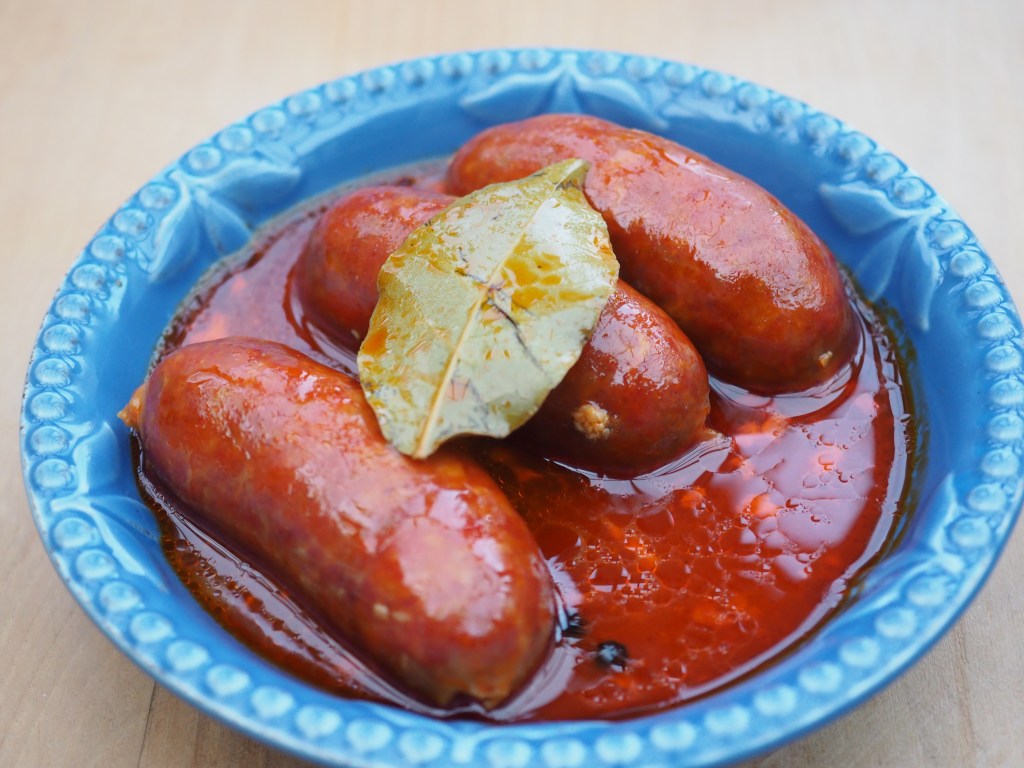
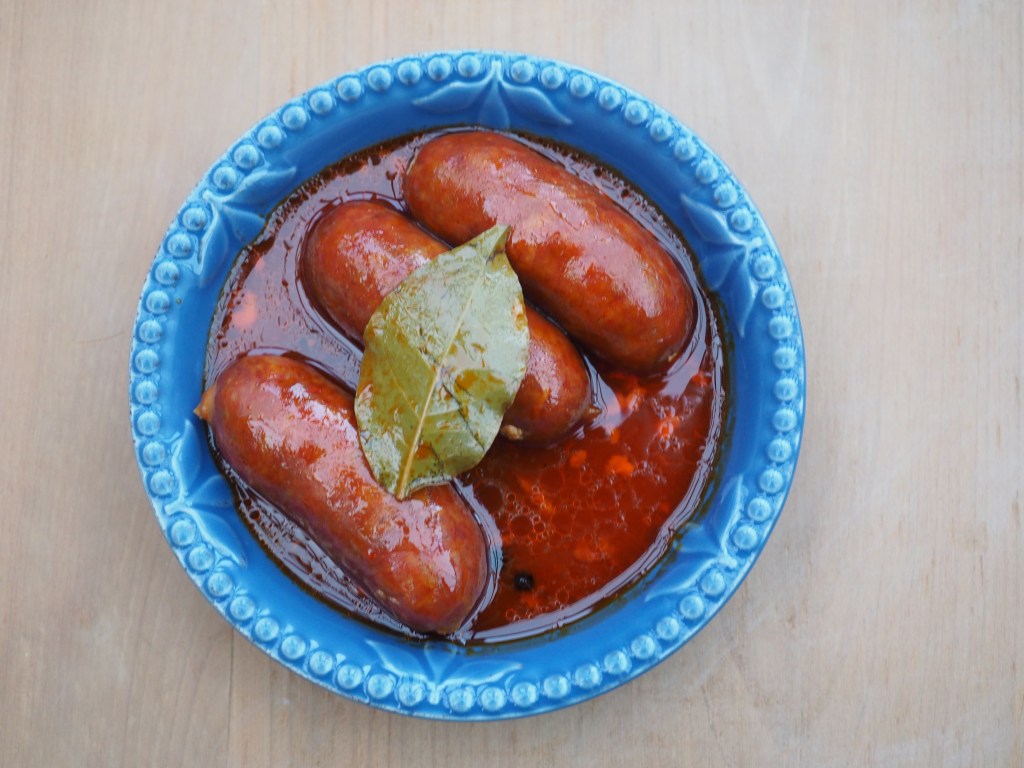
Chorizo al Sidra may not be your 1st thought for a Spanish dish but in Asturias, and in many Andalusian bars this is commonplace.
Chorizo al sidra (Chorizo in Cider)
It is incredibly easy and tastes fantastic.
In its most basic form it is fresh chorizo sausages (cooking chorizo not the dry cured) slow cooked in cider. That’s it. You can add, garlic, bay leaf, parsley.
Put the chorizo into a small pan and cover in cider. Bring to the boil then simmer for at least 20mins. The cider will reduce into a syrupy, spicy, smoky, red glaze
Best served with bread to mop things up. (It’s makes a wonderful spicy sweet sausage sandwich)
As soon as something novel and exotic appears on a TV cookery show or in a glossy food magazine its on a supermarket shelf and being used in everything from fusion tacos to dessert.
A flavour that has eluded me since I first tasted it is Chadon Beni.
Let me give you the background.
Port of Spain. Trinidad. 2014. It was the week after the queen had visited and I was staying in the same hotel. Overlooking the savannah and the botanical gardens the hotel had just opened. It is now the Brix but it may have been under a different name back then.
Serendipity played her role. In that idle time between hotel check out and travel to the airport I decided to grab a bite to eat, more out of boredom than hunger.
The menu featured chick pea soup with Chadon Beni. It caught my eye. I’d enjoyed delicious food in the preceding days. Trinidad has an amazing and unique cuisine. It’s a cuisine of history and rich with the cultural heritage of the island. The Indian, South American and African flavours come together in doubles, roti, and chokas. These are street foods that zing with Indian flavours but present themselves as a reinvention. Reminders of their origins but definitely individual and definitely Trinidadian. [for any foodie adventurers Trinidad is a treasure trove – go get some Bake n Shark at Maracas Bay].
Back to the chickpea soup. It was a pretty simple affair. Nothing fancy. Chickpeas cooked to the point of fragmentation, a bit of sweetness and starch from some sweet potato and a touch of earthy cumin. But the shine out was from a new flavour. It stunned me. It was outside the glossary of flavours my tastebuds had stored up.
Green and herbaceous, but with a perfume that was low and deep. It definitely wasn’t coriander but it did have that pungency. I enquired about it. “What is this flavour?”
Chadon Beni was the obvious but unhelpful response.
It’s a Trini herb I was informed.
“Does it have another name?”
The waitress shrugged her shoulders and took away the now empty bowl.
In the taxi to the airport I wrote down the name whilst the flavour was still whizzing around my brain.
Back home I decided to recreate this soup. I had all the ingredients except Chadon Beni. I searched around my usual haunts. Indian stores and African green grocers. Nothing no one new what I was talking about. Even in Caribbean stores I was told it wasn’t available in the UK.
I searched my books to no avail.
The internet informed me that Chadon Beni, or Culantro is a herb used in the Caribbean, particularly Trinidad and Tobago. I chase culantro as a lead but usually ended up with Cilantro. I started to get suspicious that even my spellchecker was keeping it a secret from me.
I ordered seeds which never grew and eventually got to the point of realising that my only hope of tasting it again was back in Trinidad.
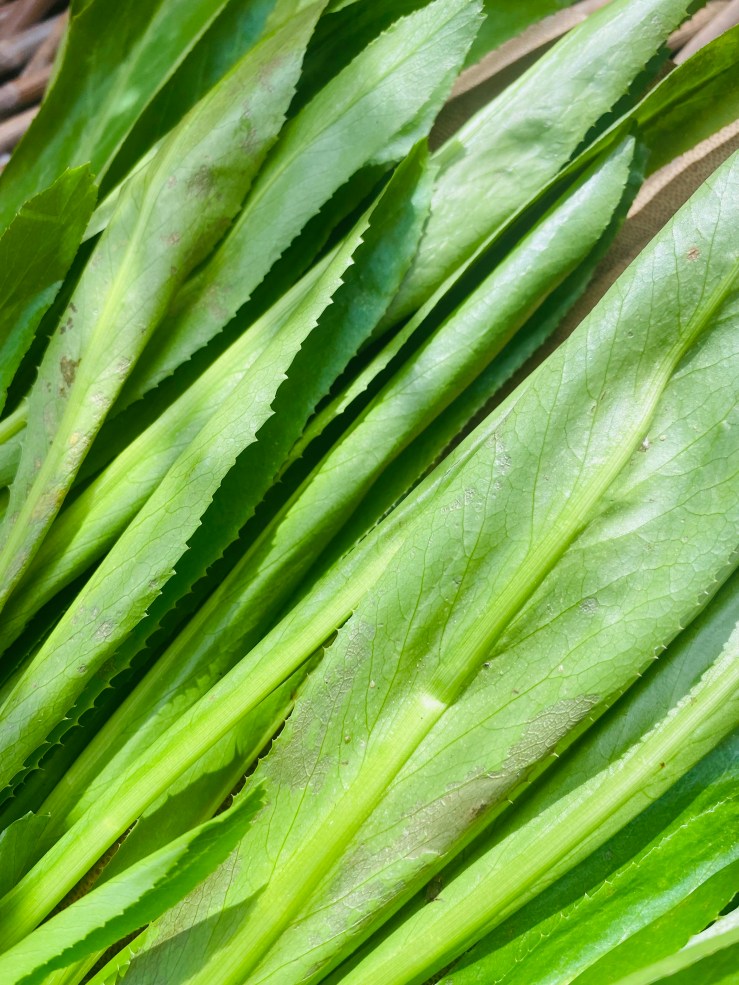
Having given up all hope I was in the Chinese supermarket and in the corner of my eye i caught a glimpse of some long green leaves with a serrated, sawtooth edge.
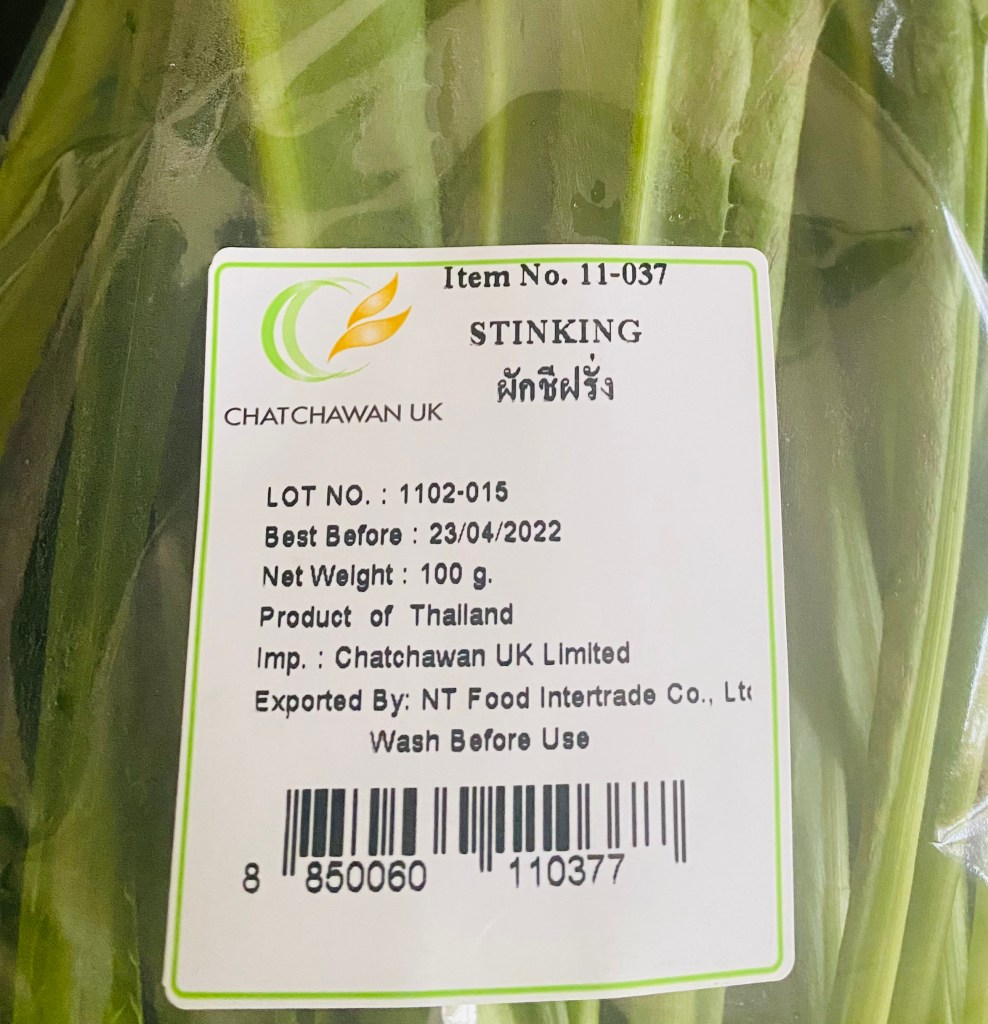
Stinking, another name for thai parsley, culantro or chadon beni
Labelled simply “stinking” on the label my heart raced with excitement. It looked like pictures I had seen. I recognised it and my extremely poor latin remembered the proper name Eryngium foetidum, hinted at bad smelling. Maybe thats where the name stinking comes from?
I grabbed two packs and whizzed home.
What I had bought was Thai parsley, also known as Stinking. Further searches took me to Long coriander, sawtooth coriander, ngo gai, bhandhania, Mexican coriander, Culantro and …Chadon Beni!
The flavour is not dissimilar to coriander but it is different. It is stated that Culantro is 7-10 time more pungent that coriander/cilantro. I don’t know how you measure that but for me the flavour is unique.
I don’t think pungent is the correct word as a lot of the flavour is subtle. It is almost a background flavour. The bassline of a tune rather than the solo. With chickpeas and other spices it seems to be a flavour enhancer, making the other flavours pronounced.
A good example Of this is the simple Trinidad green seasoning. Garlic, thyme, parsley, green onion, scotch bonnet chilli, salt and lime juice. A supercharged salsa verde that when added to a chickpea curry makes it sing.
I had to attempt to recreate the chick pea soup I had originally tasted.
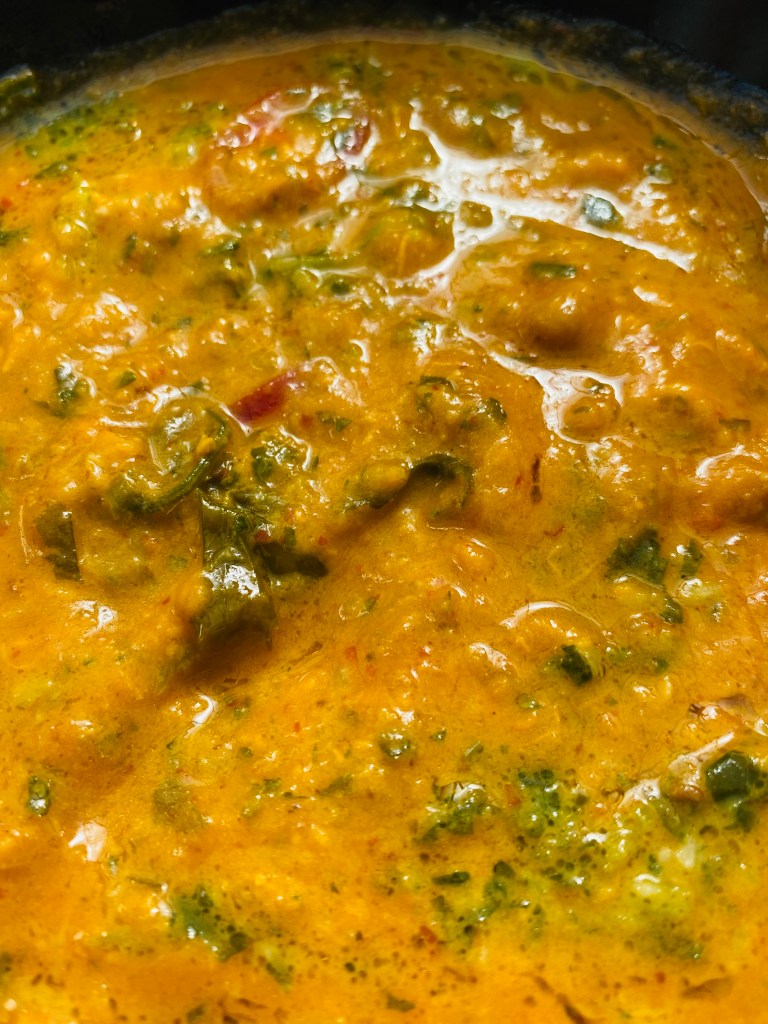
Trying to keep things simple I added a few handfuls of soaked chickpeas with a chopped sweet potato to a chopped onion, garlic and ginger gently sautéed in the InstantPot. Covered in water and gave it 30 minutes.
Stirred in a tablespoon of coconut cream, a spoon of red curry paste and a teaspoon of dry pan warmed cumin.
Served it hot with a big dollop of green seasoning.
It was there. The synapses fired again with a taste memory as fresh as the soup I tasted that day. I hope that its a regular feature now in the Chinese supermarket. If not I at least I now know what I am looking even if it remains an elusive but magical herb.
Chickpea and sweet potato soup with Chadon beniTrinidad green seasoning with Chadon Beni Trinidad chickpea soup with Chadon beni (culantro)








 Survival Rations